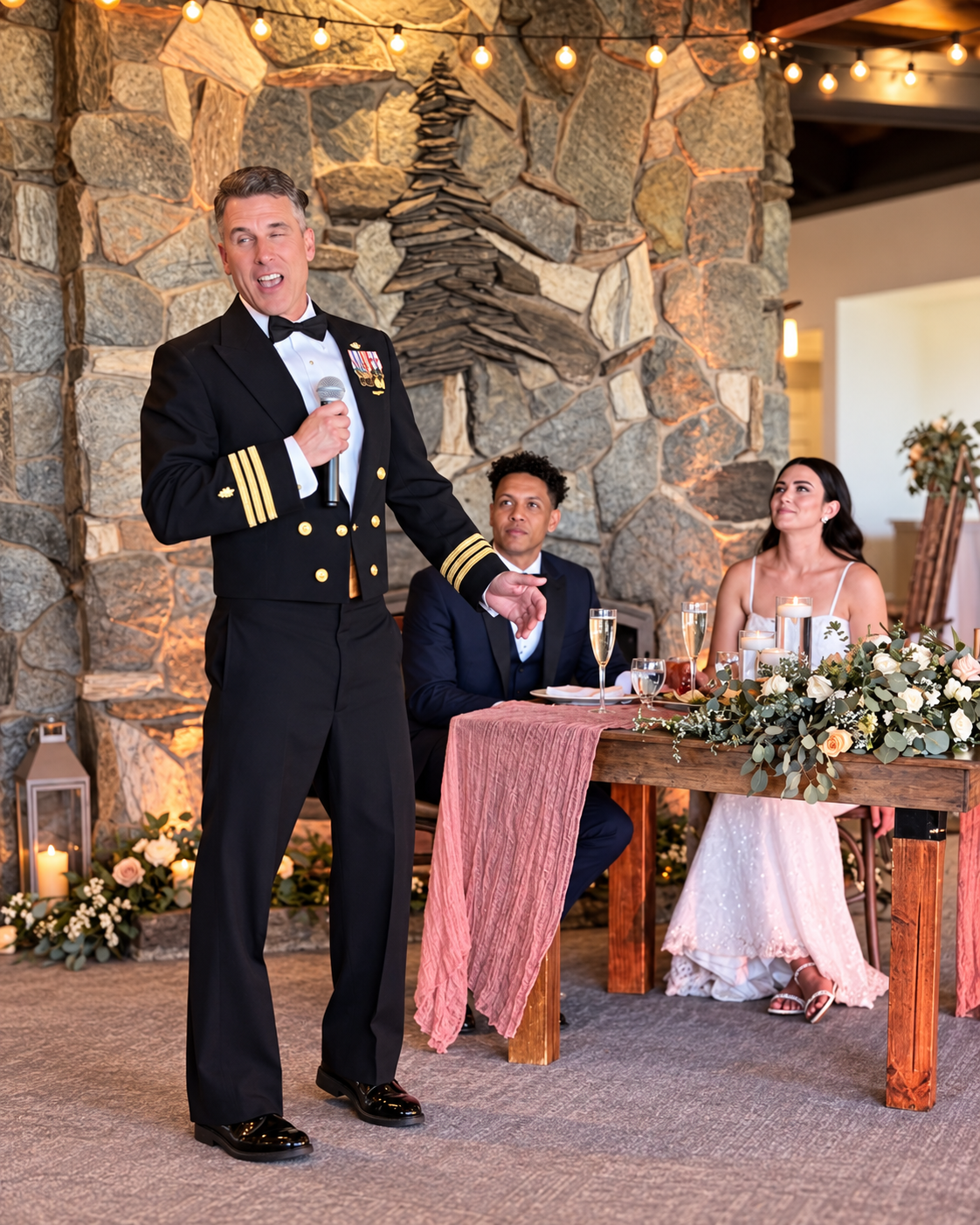
When Is the Best Time for Wedding Speeches?
For many weddings, I prefer most speeches and toasts toward the end of dinner. Guests have eaten, the room is settled, and the speeches can become a natural bridge into the next part of the reception without making hungry guests wait through a long speaking block.
A short welcome toast before dinner can also work beautifully, especially from a parent, host, or the couple.
There is no single perfect order for every wedding. East Coast traditions often place more formalities earlier, while West Coast receptions commonly move speeches later. Destination weddings around Reno and Lake Tahoe may blend both approaches.
The important thing is not simply whether speeches happen before or after dinner.
It is whether the timing protects the meaning of the toast, the meal, and the flow of the reception.
After more than 1,000 weddings, that is what I care about most.
Should Wedding Speeches Happen Before Dinner?
A short welcome before dinner can work extremely well.
At JAM Entertainment weddings, our Master of Ceremonies usually gives a formal welcome before the grand entrance. We gather the room, welcome everyone to the couple's celebration, introduce ourselves, briefly explain what guests can expect, and invite anyone who has not found their seat to do so before the wedding party enters.
That is different from a toast.
After the grand entrance, a parent, host, or the couple may give a brief welcome or thank-you before dinner begins. This can create a warm transition into the meal without requiring guests to sit through an entire block of speeches while they are waiting to eat.
The key word is brief.
One thoughtful welcome before dinner feels very different from scheduling four or five full speeches before anyone has been served.
Why I Usually Prefer Most Toasts Near the End of Dinner
For many receptions, I like the main toast block as dinner is winding down.
To me, it simply flows better.
Guests have had time to eat and talk. The room has settled. Catering is nearing the end of service. Now the focus can shift naturally toward the people and emotional moments at the center of the wedding.
I often think of reception flow like a movie. One scene should lead naturally into the next.
Dinner does not need to suddenly stop for an unrelated activity. The speeches can become the emotional transition between dinner and whatever meaningful moment comes next.
That may be cake cutting. It may be a first dance or parent dances. It may be another tradition or experience the couple chose.
The exact order can change.
The flow should not feel accidental.
Can Wedding Speeches Happen During Dinner?
They can, but catering needs to be part of the decision.
A gap that looks empty on a wedding timeline may be exactly when the kitchen needs to serve a course, clear plates, or release tables.
For a buffet, I generally would not want important speeches happening while half the room is standing in line or still getting food.
For a plated dinner, there may be a natural window toward the end of service, but the planner, catering lead, and DJ/MC should understand that timing together.
The goal is not to make catering hold hot food because somebody started talking.
And it is not to ask an emotional speaker to compete with servers clearing plates around the room.
That is why the timeline has to work in real life, not just on paper.
How Long Should Wedding Speeches Be?
For most speakers, I recommend about two to three minutes.
Parents or another especially important family member may reasonably have three to five minutes if the toast is prepared and meaningful.
The problem is rarely that someone has too little to say.
It is knowing what belongs in a wedding toast.
A great toast does not need to tell the speaker's entire history with the couple. One or two good stories, something meaningful about the relationship, and a sincere toast can be incredibly powerful.
Remember that the guests have already spent a significant amount of time seated during dinner, and more seated moments may still be coming.
A heartfelt speech can feel short to the person giving it while twenty minutes of speeches can feel very different to the room listening.
How Many Wedding Speeches Are Too Many?
As a general planning target, I like four to five speakers at most during the reception, especially if everyone stays near the two-to-three-minute range.
A traditional lineup might include the best man, maid or matron of honor, and one or both parents. But there is no requirement that speakers be chosen because of gender or title.
Choose the people who genuinely have something meaningful to say.
Also remember that every three-minute speech takes more than three minutes in the timeline. Someone has to be introduced. They need to stand and walk to the microphone. Guests applaud and laugh. There is a microphone transition. Sometimes there is a hug afterward.
Four or five speakers can very easily become a 15-to-20-minute experience.
If eight people want to speak, that does not mean eight people do not matter.
It may mean some of those beautiful tributes belong at the rehearsal dinner, welcome party, or another gathering where they can receive the time they deserve.
Why Open-Mic Wedding Toasts Are Usually a Bad Idea
I do not recommend an open microphone at a wedding reception.
A toast is supposed to honor the couple.
It is not an opportunity for someone to unexpectedly turn the reception into their own comedy set, roast the groom, embarrass the bride, tell inappropriate stories, or give a twenty-minute autobiography.
I have personally watched a parent speak for approximately 37 minutes.
I have seen an intoxicated best man continue for more than 25 minutes.
Those moments do not only affect the timeline. Eventually the speaker becomes the focus of the wedding instead of the couple.
A planned speaker list is much easier to protect.
Meaningful does not have to mean long.
What Makes a Good Wedding Toast?
A good wedding toast should make the couple feel honored.
A funny story can absolutely belong in it. Humor is wonderful when it comes from affection rather than humiliation.
The speaker does not need to prove how long they have known the groom or tell the room something embarrassing nobody else knows.
Whether the wedding has a bride and groom, two brides, two grooms, or another couple structure, the purpose is the same:
Honor the people getting married and the relationship they are celebrating.
Tell the story.
Say what they mean to you.
Raise the glass.
Then let the moment belong to them.
Should You Read a Wedding Toast From Your Phone?
You can.
But prepare for nerves.
We have watched speakers accidentally swipe away from their speech, lock the screen, lose their notes, and suddenly stand at the microphone trying to find where the toast went.
If you want to use your phone, I recommend taking a screenshot of the finished speech and keeping that image ready in your photos. That eliminates a lot of unnecessary scrolling and navigation.
Handwritten notes can be even more meaningful.
When my son got married, I wrote my toast by hand in a small notebook. After I finished speaking, I gave it to him.
Later, during his grand exit, he had his wife in one hand and that little notebook in the other.
I cannot tell you exactly what that meant to him, but I know what it meant to me.
Sometimes the piece of paper becomes part of the memory too.
Where Should Someone Stand When Giving a Wedding Toast?
At JAM Entertainment weddings, we typically prefer a microphone on a stand, positioned intentionally near the couple rather than sending a wireless microphone around the room.
There are several reasons.
The speaker stays in one predictable location. They can speak toward the couple while still addressing the room. The photographer and videographer know exactly where the speaker will be instead of chasing someone who walks around or continually turns their back to the camera.
It also makes microphone technique easier to coach.
Before speeches begin, our team prepares the speakers. We show them where they will stand, how to raise or lower the microphone, and how close they need to be.
A microphone held two feet away cannot simply be “turned up” enough to fix bad technique. Increasing the volume also increases the room noise and reflections the microphone picks up.
The practical rule is much simpler:
Stay close to the microphone and let the sound professional handle the volume.
What Should the Master of Ceremonies Do Before Wedding Toasts?
The MC should be doing much more than grabbing a microphone and saying, “Who's next?”
At JAM, we usually prepare the speakers during dinner as the meal is winding down.
We confirm the speaking order and remind them to have their notes and drink ready. We show them where the microphone will be and review the basic microphone technique. We remind them to finish with an actual toast, and that a natural hug or connection with the couple afterward is completely appropriate.
The MC should also confirm that the couple is present, the photographer and videographer are ready, catering is in a workable place, and the room is prepared to listen.
Then the speaker should be formally introduced.
Instead of:
“Give it up for Tom!”
I prefer something like:
“Ladies and gentlemen, please help me welcome the father of the bride, Mr. Stephen Holgate.”
The person's name comes last.
That gives the introduction context, importance, and professionalism.
It also means the speaker does not need to begin with:
“For those of you who don't know me…”
We have already told the room who they are.
Do Guests Need Champagne for Wedding Toasts?
Not necessarily.
But decide beforehand.
If the couple wants a formal champagne toast, catering needs to know when champagne should be poured and how that service fits with dinner.
If guests are simply toasting with whatever they already have, tell them.
At JAM, we also like to give guests advance notice before speeches begin. Something as simple as letting the room know that toasts will begin shortly gives people time to refresh a drink, return from the restroom, or finish a conversation before everyone's attention shifts.
That is a small detail.
Small details are what make live events feel polished.
What Should Happen Immediately After the Wedding Speeches?
There is no single answer.
The couple may give a brief thank-you to close the toast block, which I personally love.
From there, the next moment should connect naturally.
Often we move into the cake cutting. But we do not treat cake cutting as something that exists simply because it appears on a wedding checklist.
We explain the moment and give it context.
Sometimes there is no cake. Maybe the next scene is the couple's first dance, parent dances, another cultural tradition, or something completely personal.
The question I am always asking is:
What makes sense next?
A well-designed reception should not feel like somebody is checking boxes.
It should feel like one moment is leading into another.
What Happens If a Wedding Speech Runs Too Long?
Preparation is much better than publicly cutting someone off.
We communicate the expected two-to-three-minute target before the speeches begin, and the couple can reinforce that expectation with their speakers before the wedding.
Occasionally someone decides they are going to speak much longer anyway.
We generally do not embarrass the speaker by interrupting them publicly unless there is an extraordinary reason.
Instead, the professional team adjusts what follows.
But a speaker should understand something important: taking an extra twenty minutes does not create twenty new minutes in the wedding.
That time usually comes from somewhere else the couple intentionally planned.
A thoughtful toast respects the couple's relationship and their reception.
What Changes for a Reno or Lake Tahoe Wedding?
Northern Nevada weddings bring some unique considerations.
Reno and Lake Tahoe generally follow more of a West Coast reception style, where toasts often happen later in the evening. But Reno-Tahoe is also a destination wedding market.
We regularly work with couples and families bringing East Coast traditions, international traditions, cultural traditions, and entirely different expectations for the order of the evening.
We adapt.
Lake Tahoe also adds one extremely important variable:
sunset.
If the light is suddenly perfect and the photographer needs the couple for sunset portraits, protecting that opportunity may be more important than rigidly following the toast schedule.
We have paused a toast sequence before because the sun was going down. We calmly explained to guests that we were taking a brief intermission so the couple would not miss those photographs, invited guests to enjoy the view and take their own pictures, and told everyone exactly when we would return.
Then the photographer also has to respect the agreed return time.
That is what a flexible timeline should look like.
The schedule serves the experience.
The experience should not become a slave to the schedule.
Final Thoughts
Wedding speeches are not simply another item on the reception checklist.
They are an opportunity for some of the most important people in your life to pause the celebration and tell you what you mean to them.
Give those words enough space to matter.
But do not make guests wait indefinitely for dinner. Do not schedule more speakers than the room can reasonably absorb. Do not turn the microphone into an open invitation. And do not assume that a heartfelt toast has to be twenty minutes long to be meaningful.
For many weddings, I prefer a brief welcome before dinner and the main speeches toward the end of dinner, followed by a couple's thank-you and whatever meaningful moment naturally belongs next.
But there is no perfect template.
The best timing is the timing that makes sense for your couple, your meal, your speakers, your traditions, and the experience you want your guests to have.
That is the difference between following a wedding timeline and actually designing one.
Frequently Asked Questions
Is it better to have wedding speeches before or after dinner?
For many weddings, JAM Entertainment prefers the main toast block toward the end of dinner, when guests have eaten and the speeches can naturally lead into the next part of the reception. A brief parent, host, or couple welcome before dinner can also work very well.
How long should a wedding speech be?
For most speakers, about two to three minutes is a strong target. A parent or another especially important family member may reasonably speak for three to five minutes when the toast is prepared and meaningful.
How many people should give speeches at a wedding?
JAM generally recommends keeping the reception speaker list to roughly four or five people when possible. Additional tributes can be moved to a rehearsal dinner, welcome gathering, or another event.
Should wedding speeches be open mic?
JAM generally does not recommend an open microphone during the wedding reception. A planned speaker list protects the timeline and reduces the risk of unexpectedly long, inappropriate, or uncomfortable speeches.
Can wedding speeches happen during dinner?
Yes, if catering confirms there is a workable pause. Avoid important speeches while guests are still being served, standing in a buffet line, or while staff are actively clearing around the speaker.
Should I read my wedding speech from my phone?
You can, but consider saving the final speech as a screenshot so it is easy to find without scrolling or navigating apps. Handwritten or printed notes are another reliable option and can even become a keepsake for the couple.
Who should introduce wedding speeches?
The professional Master of Ceremonies should generally introduce each scheduled speaker, confirm the room and vendor team are ready, and manage the transition between speakers.
Where should someone stand while giving a wedding toast?
JAM prefers a planned speaking position with a microphone stand near the couple when the room allows it. This helps guests hear clearly and gives the photographer and videographer a predictable angle for capturing the moment.