Wedding DJ vs. Playlist vs. Club DJ: What Couples Actually Need for a Wedding Reception
A playlist, a club DJ, an announcement-style DJ, and a true wedding DJ/MC are not the same thing.
They can all play music. Some can all keep a party moving. Some can all make basic announcements. But a wedding reception usually needs more than music. It needs someone who can read the room, protect the timeline, guide transitions, speak with polish, adjust to the couple and the guests, and understand the emotional flow of the night.
That is the real difference.
Many couples do not know to ask about that difference. And honestly, many DJs use words like “wedding DJ” or “MC” without clearly defining what those roles actually mean. A DJ may be talented, experienced, and well-intentioned, but that does not automatically mean weddings are their specialty.
The goal is not to tear anyone down. The goal is to help couples understand what they are actually hiring.
At JAM Entertainment, we believe the best weddings are not held together by a playlist alone. They are held together by music, timing, communication, preparation, and the right voice at the right moment.
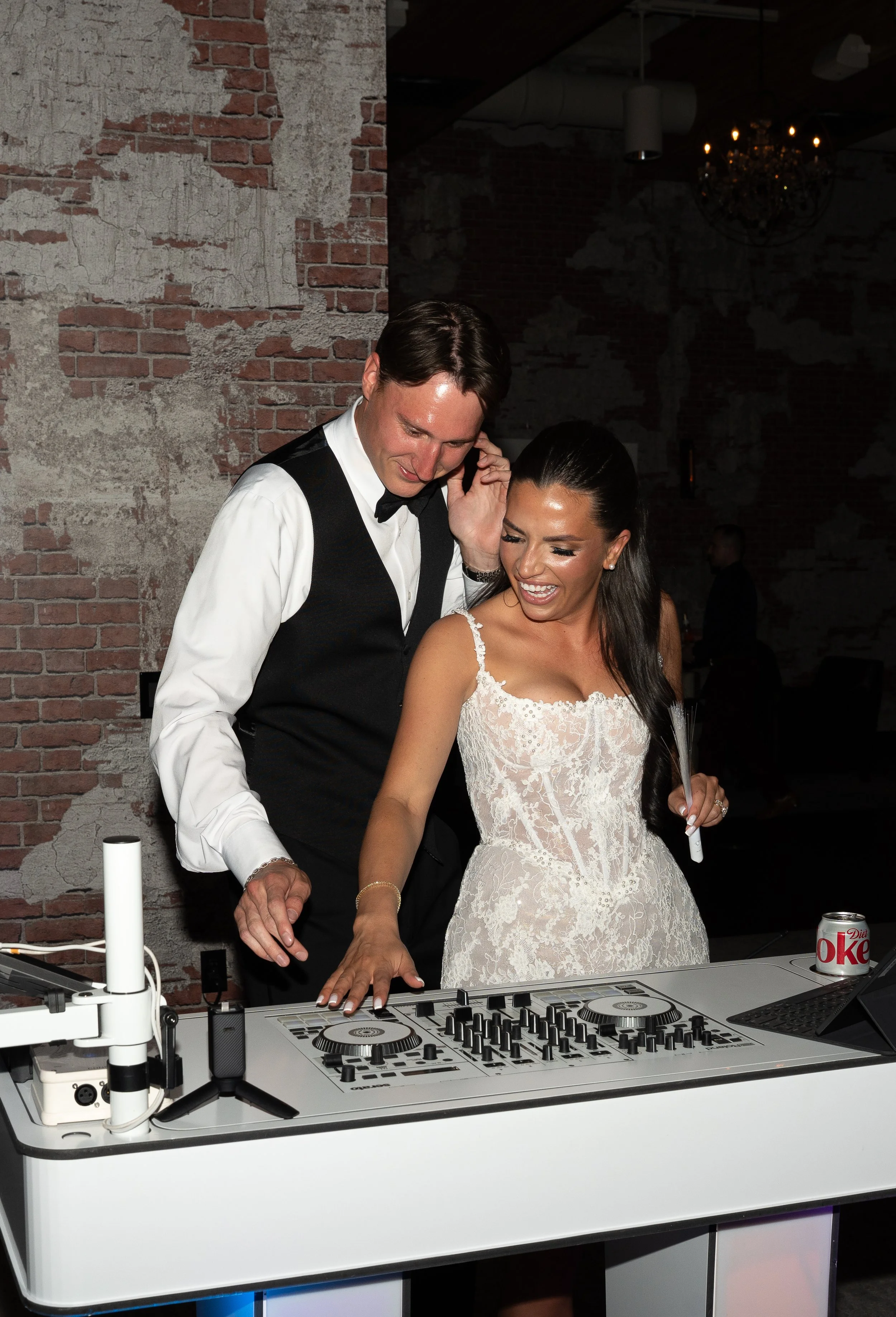
A playlist, club DJ, announcement-style DJ, and true wedding DJ/MC can all play music, but they do not create the same wedding experience. This guide explains the difference so couples can choose the right fit for their reception, timeline, announcements, dance floor, and emotional flow.
Photo By Brooke Wilson Photography
The real question is not “Can they play music?”
Almost anyone can play songs.
A playlist can do that. A bar DJ can do that. A club DJ can do that. A wedding DJ can do that.
The real question is whether they know how to guide a wedding reception.
Can they manage the shift from dinner to toasts? Can they introduce a parent dance with the right tone? Can they adjust when the timeline runs late? Can they work with the planner without needing to be micromanaged? Can they read a mixed-generation dance floor? Can they speak into the microphone without sounding like an airport announcement or a hype show?
That is where the difference shows.
A true professional wedding DJ and Master of Ceremonies is not just playing music at a wedding. They are helping shape the reception experience.
Quick guide: playlist, club DJ, announcement DJ, or wedding DJ/MC?
| Option | Best For | Main Limitation |
|---|---|---|
| Playlist | Simple gatherings, background music, casual events, or couples who want full song control. | Cannot read the room, adjust live, make polished announcements, or protect the timeline. |
| Club DJ | High-energy dance sets, nightlife-style events, and music-forward parties. | Club skill does not automatically translate into wedding pacing, guest range, formalities, or emotional transitions. |
| Announcement-Style DJ | Basic introductions, dinner announcements, and simple formalities. | Announcements alone are not the same as full MC leadership, tone control, or room guidance. |
| Professional Wedding DJ/MC | Ceremony sound, reception flow, announcements, music, crowd-reading, transitions, and guest experience. | Requires choosing the right professional fit, not just someone with equipment, song access, or a microphone. |
Each option can work in the right setting. The key is knowing what kind of wedding experience you actually want.
What a playlist can do well
A playlist can be a useful tool.
Spotify, Apple Music, and AI-assisted music recommendations have come a long way. Couples can build thoughtful playlists that reflect their taste, their memories, and the songs that matter most to them.
A playlist can work well for cocktail hour, dinner background music, welcome parties, after-parties, or very simple celebrations where formalities are minimal. It can also help your DJ understand your style, because your must-play songs, favorite artists, do-not-play list, and general music preferences are all valuable.
A professional wedding DJ should want to understand what you love, what you dislike, and what kind of energy you imagine for the night.
So the issue is not whether playlists are useful.
They are.
The issue is whether a playlist can carry the responsibility of the entire wedding reception.
What a playlist cannot do at a wedding
A playlist cannot read the room.
It cannot see that older guests are finally getting up, so the next song should keep them engaged for one more moment. It cannot notice that the dance floor is thinning because the music shifted too far in one direction. It cannot adjust because dinner ran late, toasts went long, or the photographer needs two more minutes before the first dance.
A playlist also cannot speak.
It cannot welcome guests with warmth. It cannot pronounce family names correctly. It cannot invite people into a moment with elegance. It cannot calm the room, redirect attention, or help a transition feel natural.
Most importantly, a playlist cannot recover when something changes.
Weddings change. Timelines move. People are late. Weather shifts. Catering needs more time. A bustle takes longer than expected. Guests are not always where they are supposed to be.
When that happens, someone has to make judgment calls. That is where a playlist reaches its limit.
Why a club DJ is not always the same as a wedding DJ
A great club DJ can be incredibly talented.
They may have strong mixing skills, deep music knowledge, technical ability, and the confidence to control a dance floor. For the right event, that can be excellent.
But a wedding is not always the same as a club.
A club DJ often plays for a specific crowd, a specific sound, a specific room, and a specific energy. A wedding DJ has to play for multiple generations, different friend groups, family members, cultural preferences, formal moments, and the couple’s personal taste.
At a wedding, the DJ may need to move from ceremony music to cocktail hour, then dinner, then introductions, then first dance, parent dances, toasts, open dancing, cake cutting, private last dance, or grand exit. That requires more than mixing. It requires pacing, restraint, and knowing when to build energy and when to protect a moment.
A club-style set can be great for the right couple and the right reception. But if the DJ is only focused on their personal mix, their preferred genre, or one narrow lane of music, the wedding can start to feel like it belongs more to the DJ than to the couple.
That is not what most couples want.
The best wedding DJs understand that the music should reflect the couple, serve the guests, and support the flow of the night.
Why “wedding DJ” can mean different things
One of the hardest parts for couples is that many entertainment companies use the same words, but they do not always mean the same thing.
A DJ may promote themselves as a wedding DJ because they are willing to play weddings. Another may say they are a DJ/MC because they can make announcements. Another may be a talented club or bar DJ who is now adding weddings because the demand is there.
That does not automatically make them bad.
It does mean couples need to understand what they are actually hiring.
Wedding DJ work is its own specialty. A great club DJ may be excellent at mixing, building a set, and creating nightlife energy. A playlist-style DJ may be able to play requested songs cleanly. An announcement-style DJ may be comfortable introducing the wedding party and calling guests to dinner.
But those are not always the same as guiding a wedding reception.
A true wedding DJ/MC understands music, timing, formalities, guest range, emotional flow, vendor coordination, microphone tone, and how to adjust when the night changes. They are not just asking, “What song comes next?” They are watching what the room needs next.
That distinction matters because couples often do not know what to ask. If a DJ says, “Yes, we MC the wedding,” the better follow-up question is:
What does MC work mean in your process?
Do they simply make announcements? Do they guide the timeline? Do they coordinate with the planner, photographer, catering team, and venue before major moments? Do they help set the tone before a first dance, parent dance, toast, or grand entrance? Do they have real wedding footage that shows their microphone style?
Those questions help couples move beyond labels and understand the actual experience.
No one is an expert at every type of DJing. Club work, bar work, corporate events, private parties, festivals, and weddings all require different skills. The best professionals are honest about their lane, their strengths, and the kind of events they serve best.
For couples, the goal is not to find the loudest promise. The goal is to find the right fit.
If you only want song selection and basic announcements, a simpler DJ setup may be enough. If you want emotional flow, polished transitions, ceremony support, crowd reading, and a guided reception experience, you should look for someone whose work clearly shows that weddings are not an occasional add-on. They are a real specialty.
The difference between an announcement person and a true Master of Ceremonies
This is one of the most important distinctions couples can understand.
Many DJs describe themselves as a DJ/MC. But not every MC style is the same.
For some, MC work means making basic announcements. “Dinner is ready.” “Come to the dance floor.” “It is time for speeches.”
Those announcements may technically get the job done, but they do not always shape the feeling of the room.
A true wedding Master of Ceremonies does more than announce what is happening next. A strong MC understands tone, timing, pacing, emotion, guest attention, and how each moment should feel.
There is a difference between saying, “Dinner time,” and saying, “Ladies and gentlemen, at this time, we invite you to enjoy dinner service. Please remain comfortably seated, and our catering team will begin with the first tables shortly.”
That difference may seem small on paper. It is not small in the room.
One version feels abrupt. The other feels guided.
The goal is not to sound overly formal or theatrical. The goal is to match the tone of the wedding. A black-tie reception, a Lake Tahoe resort wedding, a backyard celebration, and a high-energy party may all need different microphone styles.
The best MCs do not take over the wedding. They support it.
They help moments land cleanly. They help guests know what to do without feeling commanded. They work with the planner, photographer, venue, catering team, and couple so the reception feels smooth instead of scattered.
That is the difference between making announcements and truly hosting a wedding.
Why watching video matters when choosing a wedding DJ or MC
Written reviews matter. They can show consistency, trust, and how couples felt after the wedding.
But video can show something reviews cannot.
A written review may say the DJ was amazing, the dance floor was packed, or the night was perfect. That is helpful. But it does not always show how the DJ sounded on the microphone, how they handled transitions, or whether their style would match your wedding.
When a DJ or MC says they are polished, elegant, high-energy, refined, funny, or professional, couples should be able to see and hear what that means.
Watch video when possible.
Listen for the tone. Does the MC sound warm? Rushed? Overly casual? Too loud? Too scripted? Too much like a hype person? Or do they sound calm, confident, and connected to the room?
Look at how transitions feel. Are guests being guided naturally? Does the couple seem comfortable? Do the announcements match the style of the wedding? Does the DJ understand when to bring energy and when to step back?
This is one reason JAM Entertainment values real event footage and video testimonials. Couples should not have to guess what the experience feels like. They should be able to see and hear the style before trusting someone with the microphone.
A wedding DJ’s music matters. A wedding MC’s voice matters too.
Why reading the room matters more than playing the perfect playlist
Couples often spend a lot of time choosing songs.
That is a good thing. Your music should feel personal.
But even a perfect playlist cannot predict the room.
A reception is alive. The energy changes throughout the night. Guests respond differently than expected. A song that looks perfect on paper may not work in the moment. A song you almost forgot about may become the one that opens the floor.
A professional wedding DJ is not just playing songs. They are watching behavior.
Who is dancing? Who is almost ready to dance? Are the older guests still engaged? Are the college friends taking over too early? Is the room ready for a singalong? Does the couple want a packed floor, or do they prefer a more elegant, balanced feel?
Reading the room does not mean ignoring the couple’s taste. It means using the couple’s taste as the foundation, then making live decisions that serve the guests and the moment.
That is where experience matters.
The best DJs know how to honor the couple’s playlist without becoming trapped by it. They know when to stay in a lane, when to shift, when to shorten a song, when to let a moment breathe, and when to bring the energy back.
That is something software cannot fully replace.
When a playlist might be enough
A playlist may be enough for some events.
If you are hosting a very small gathering, a casual dinner, a backyard celebration with no formalities, or an event where music is mostly background, a playlist may work just fine.
It can also be a good fit if you truly do not need announcements, ceremony audio, timeline guidance, dance floor management, or live adjustments.
There is nothing wrong with that.
The key is being honest about what the event requires.
If your wedding has a ceremony, processional music, microphones, introductions, toasts, dinner coordination, first dance, parent dances, open dancing, and a formal flow, a playlist may not be enough by itself.
At that point, the question becomes less about music and more about leadership.
When a club-style DJ might be the right fit
A club-style DJ may be the right fit if the couple wants a nightlife feel and the guest list matches that energy.
Some weddings are built around dancing. Some couples want strong mixes, big transitions, electronic music, hip-hop sets, or a party atmosphere that feels closer to a lounge, club, or festival-style reception.
That can be amazing when it fits the couple and the crowd.
The caution is making sure the DJ also understands weddings.
Can they handle ceremony sound? Can they make polished introductions? Can they adjust for grandparents, parents, family friends, and guests who may not live in one music lane? Can they support the timeline? Can they step out of performer mode and serve the couple’s event?
If yes, a club-influenced wedding DJ can be fantastic. If no, the reception may become a performance instead of a celebration.
When hiring a professional wedding DJ/MC is worth it
A professional wedding DJ/MC is worth it when you want someone responsible for more than pressing play.
That includes ceremony music, microphones, guest arrival music, cocktail and dinner atmosphere, formal introductions, first dance, parent dances, announcements, timeline awareness, planner and venue coordination, reading the room, adjusting music live, and protecting the couple’s desired tone.
A strong wedding DJ/MC helps the event feel connected.
They know when to speak and when silence is better. They know when a moment needs energy and when it needs elegance. They know how to guide guests without making the wedding feel like a show they are starring in.
That balance matters.
The couple should always remain the center of the celebration.
How JAM approaches music, MC work, and guest experience
At JAM Entertainment, we do not believe a wedding DJ should impose their personal style on the room.
The wedding should sound like the couple, feel good to the guests, and move with intention.
That starts with planning. We want to understand the couple’s music taste, their must-play songs, their do-not-play songs, their family dynamics, their timeline, their venue, and the kind of energy they want to create.
It also means understanding the room in real time.
A Reno ballroom, a Lake Tahoe resort, a Napa Valley winery, and a Las Vegas celebration may all require different pacing. A wedding with 80 guests does not always move the same way as a wedding with 250. A guest list full of dancers may need a different approach than a family-centered reception where emotional moments matter most.
The goal is not to force a formula.
The goal is to lead with taste, timing, and care.
That is what separates equipment from experience.
Questions couples should ask before choosing
Before choosing a playlist, club DJ, announcement-style DJ, or professional wedding DJ/MC, ask better questions than “Do you play weddings?”
Ask what their wedding process actually includes. Ask how they handle ceremony sound, formal announcements, timeline changes, guest energy, and coordination with the planner, photographer, catering team, and venue.
Ask what MC work means in their process. Ask whether they simply make announcements or actively help guide the flow of the reception. Ask if they have real event footage where you can hear their microphone style and see how they move the room through important moments.
Ask whether their reviews mention flow, communication, timing, and guest experience, or only that the music was fun.
Those questions will tell you more than a package name ever will.
Final answer: what do couples actually need?
Couples do not need the most expensive option just because it exists.
They need the right fit.
A playlist can work for simple music needs. A club DJ can work for a high-energy, nightlife-style reception. An announcement-style DJ can help with basic formalities.
But if your wedding needs ceremony sound, polished microphone work, music judgment, timeline awareness, crowd reading, emotional pacing, and someone who can guide the room without taking over, you are probably looking for a professional wedding DJ and Master of Ceremonies.
The real question is not whether music will play.
The real question is whether the person or system behind the music can support the wedding when the moment matters.
That is where the difference shows.
FAQ
Can we use Spotify or Apple Music instead of a wedding DJ?
Yes, some couples can use Spotify or Apple Music for simple gatherings, background music, or very casual events. The limitation is that a playlist cannot read the room, make announcements, manage timing, adjust to guest energy, or recover when the schedule changes.
Is a club DJ good for a wedding?
A club DJ can be great for the right wedding, especially if the couple wants a nightlife-style dance floor. The key is making sure the DJ also understands wedding pacing, announcements, ceremony needs, guest age range, and formal transitions.
How can we tell if someone is truly a wedding DJ?
Look beyond the title and ask what their wedding process actually includes. A true wedding DJ/MC should be able to explain how they handle ceremony sound, announcements, timeline flow, guest energy, formalities, planner coordination, and unexpected changes. Video is especially helpful because it lets you hear their microphone style and see how they guide a real room.
What is the difference between a DJ and a Master of Ceremonies?
A DJ manages the music. A Master of Ceremonies guides the flow of the event with microphone work, announcements, timing, tone, and guest direction. Some professionals do both well, but couples should ask what “MC” actually means in that person’s process.
Why does the MC’s speaking style matter?
The MC’s voice helps shape how the wedding feels. A polished MC can guide guests with warmth and confidence, while a rushed or overly casual announcement can make a moment feel less intentional. The goal is not to sound fancy. The goal is to match the tone of the wedding.
Should we ask to see video of our wedding DJ or MC?
Yes. Video helps you hear the DJ or MC’s microphone style, tone, pacing, and presence. Written reviews are helpful, but video gives you a clearer sense of whether their style fits your wedding.
Can a playlist keep a dance floor full?
A playlist can include great songs, but it cannot adjust in real time. A strong dance floor usually depends on timing, crowd reading, song order, guest mix, and knowing when to shift energy.
What should we look for in a professional wedding DJ/MC?
Look for someone who understands music, timing, announcements, ceremony audio, guest experience, and event flow. Reviews, planning process, video footage, and real conversations can help you understand whether they are the right fit.